Colorado Parks and Wildlife
Because of severe flooding in Durango and across southwest Colorado, offices for Colorado Parks and Wildlife in Durango and at Navajo State Park were closed Monday, Nov. 2.
Given the office closures and the loss of power, internet and cell service, CPW offices in Durango and Navajo State Park are unable to answer phones at this time.
“The historic flooding event we are experiencing is impacting our communities, our partners and our agency in a multitude of ways,” said CPW Southwest Region Manager Cory Chick. “This is a dynamic situation with conditions changing hourly. Please understand that what southwest Colorado is facing right now is a disaster that will take considerable time to work through. As we all do our best to take care of our families, properties and neighbors, our staff will be working tirelessly to help in every way possible.”
CPW staff are responding to the natural disaster in a multitude of ways across the San Luis Valley, at Navajo State Park and areas west of Wolf Creek Pass. CPW has also deployed its swiftwater rescue team to Archuleta County to assist with operations.
Navajo State Park
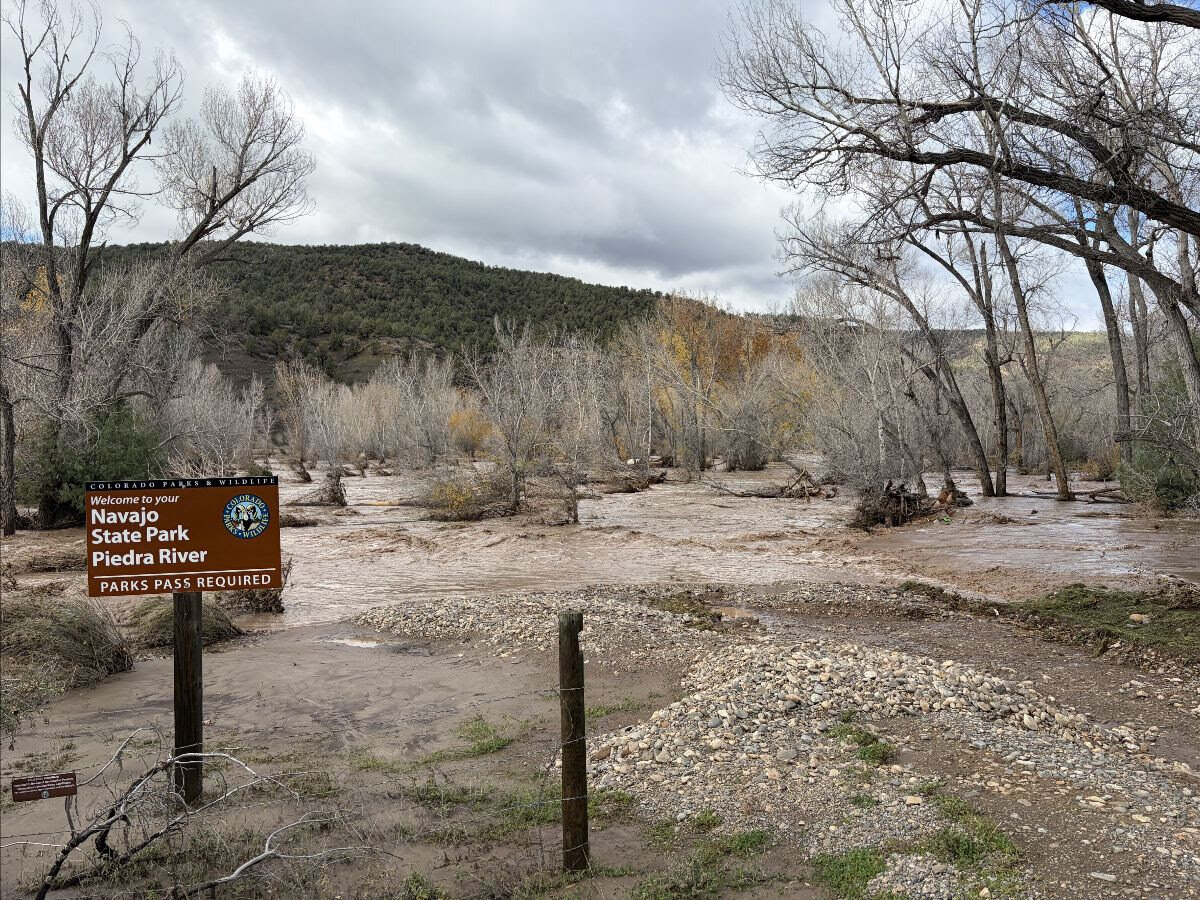
Staff at Navajo State Park have had a front-row seat to the devastation but have worked tirelessly both at the park and in surrounding communities while the San Juan River and Piedra River hit historic highs with as much as 45,000 cfs pouring into the reservoir. The reservoir has raised 51 feet since Sept. 18, an incredible amount for a 35-mile long reservoir with 15,600 surface acres.
At this time, all Piedra River access at Navajo State Park is closed. The Sambrito Wetlands area is also temporarily closed. Access to the park is limited to Highway 151 on the west side of the park in Arboles. Access on Highway 151 from the north between Chimney Rock and Arboles is completely cut off.
The visitor center at Navajo State Park will be indefinitely closed Mondays and Tuesdays. The boat ramp and Aquatic Nuisance Species station are closed for the season.
Several campsites at the park remain open and are available if residents under evacuation need assistance. Staff at the park are available to assist those in need.
Durango Fish Hatchery
The Durango Fish Hatchery has experienced catastrophic flooding from the Animas River and Junction Creek. The Animas River reached 13,000 cubic feet per second mid-morning, the second-highest level ever recorded and highest since the flood of 1911.
Hatchery staff is working around the clock to pump water away and position sandbags to protect the property and fish.
Hunting Impacts
CPW is working alongside incident commands in Archuleta and La Plata Counties as well as the Rio Grande National Forest and San Juan National Forest to determine impacts to properties. However, staff cannot safely get into the field to assess conditions that are believed to be widely dangerous and unpassable. The national forest is advising people to delay travel to the forest until assessments can be made regarding conditions.
At this time, travel to Game Management Units (GMUs) 74, 741, 75, 76, 77, 78, 79, 80 and 81 is strongly discouraged.
While parts of the affected GMUs may remain open, access to specific areas may be restricted due to conditions, closures or evacuations. You may need to plan to hunt in a different, accessible portion of your valid GMU.
If you are no longer interested in hunting in this unit, CPW will offer refunds and the restoration of preference points to pre-draw level for all hunters holding a license with the following hunt codes: DM075O3R, DF075O3R, DM075P3R, DF075P3R, DM077O3R, DF077O3R, DM077P3R, DM074O3R, DM074P3R, DM741O3R, DM741P3R, DF741P3R, DM080O3R, DF080O3R, EF074O3R, EF075O3R, EF077O3R, EF741O3R, EF080O3R, and EF081O3R
Licenses must be returned prior to the season opening (postmarked or dropped off at a CPW or State Park Office before close of business). If hunters wish to receive a refund for their license and have preference points restored to pre-draw level, they must fill out the form
found here and return it with their license. Those seeking a refund should be sure to mark both the refund box and the preference point restoration box along with writing “SW FLOODING” in the reason for the refund field.
Impacted hunters with a license for these hunt codes will receive an email. For license return questions, please call 303-297-1192.
Hunters with over-the-counter (OTC) licenses have time to adjust and make alternative plans ahead of the start of the third rifle season Nov. 7. OTC bull elk hunters are highly advised they do not try to hunt any of these GMUs during the third rifle season.
Road and Property Closures
Several major road closures exist across southwest Colorado. For the latest highway closures, go to cotrip.org. Be advised that conditions continue to change rapidly.
The latest road and trail conditions for the Rio Grande National Forest and
San Juan National Forest can be found online.
CPW continues to determine access to and condition of State Wildlife Area (SWA) properties. At this time, closures are in place of Devil Creek SWA, Higel SWA, Hot Creek SWA, Rio Grande SWA and Shriver-Wright SWA. Additional closures may be put in place as conditions warrant.
“Conditions are extremely dangerous,” said CPW Area Wildlife Manager Rick Basagoitia of Monte Vista. “Even in places where the forest service has been able to punch through and open some roads and develop workarounds, we strongly advise against traveling into these places. While many hunting areas will still be accessible, a large number of hunters will all be funneled into the same areas because of access routes being closed off in other areas. Hunters need to make the decision for themselves if they want to crowd into these open areas.”
Water Quality
CPW Water Quality Program Manager Melynda May reported multiple major spills or complete destruction of sewage treatment plants across southwest Colorado. As a result, much of the flood water is contaminated.
“Please avoid coming into contact with floodwaters as much as possible, keep any open wounds away from water, and wash any skin that comes into contact with floodwaters with soap and water as soon as possible,” May said. “Alcohol gels are better than nothing but are not a substitute for soap and water.”


 >