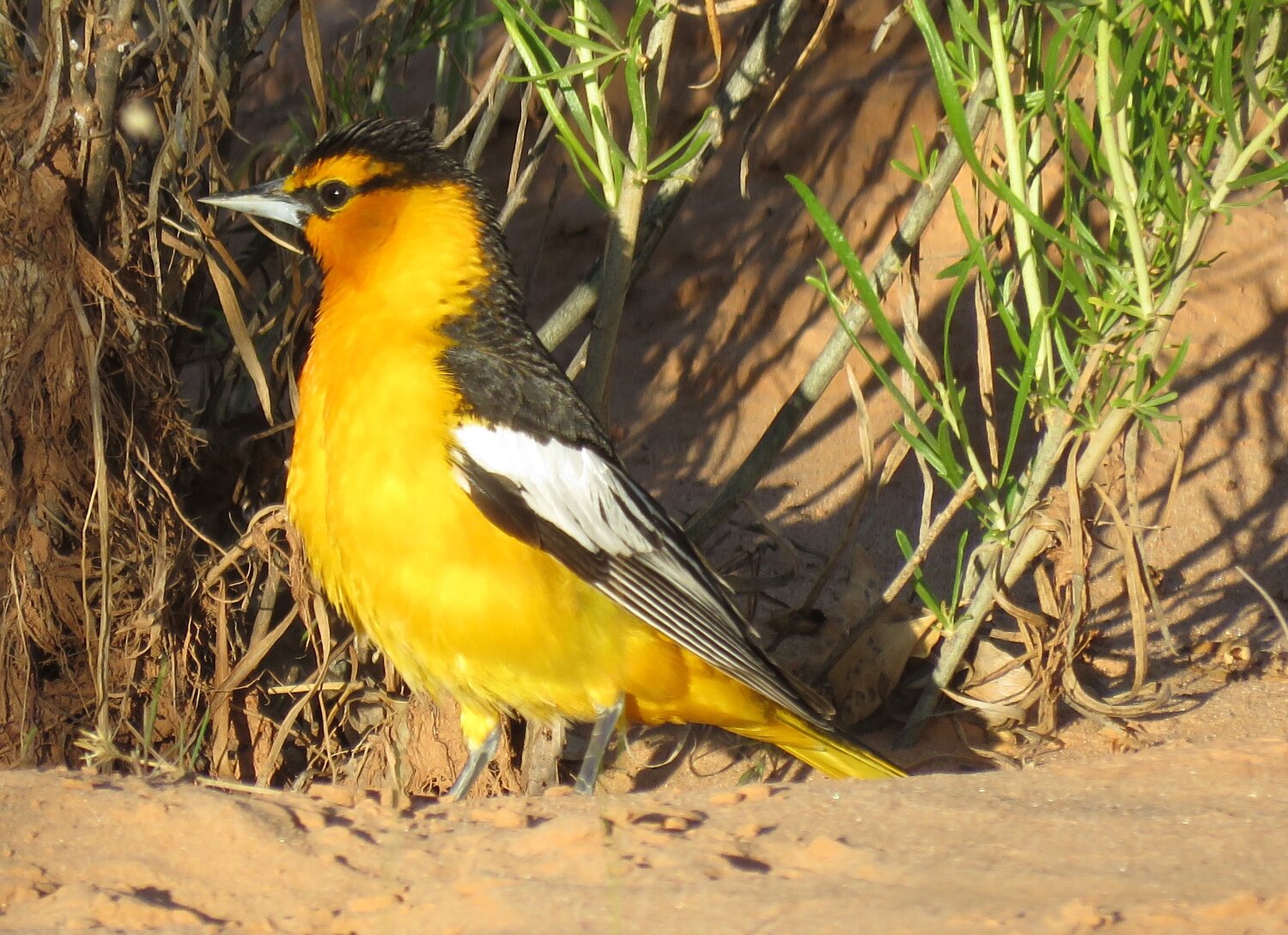
This week’s Bird of the Week, compliments of the Weminuche Audubon Society and Audubon Rockies, is the Bullock’s oriole.
These excellent weavers are known for constructing the hanging nests you may have seen in trees along the Riverwalk or along the trail near the river at Yamaguchi South. Although typically the female does most of the work, both members of a pair assist in nest building, with one working on the inside and the other outside. It may take up to 15 days to create a gourd-shaped nest from 4 to 15 inches deep that is woven using hair, grasses, twine and wool.
Cottonwoods in riparian woodlands are a favorite tree for nest placement. To discourage predation by tree-climbing animals, Bullock’s orioles suspend the nest from the tips of flexible branches high in the tree. The nest is firmly attached to branches in three spots, around the rim and at both sides.
Most of these neotropical migrants arrive in late spring from western Mexico or farther south to nest in western states, but some travel as far as southern Canada and others only to northern Mexico. With brilliant orange coloring, male Bullock’s orioles show up with a tropical look. Black on the crown, around the eyes, on the neck, back and wings, and a white wing patch provide a striking contrast. Females and immature birds are a duller yellow color and have grayish wings and backs.
These acrobatic orioles eat insects and other arthropods, which they glean from the leaves, branches and trunks of shrubs and trees. Caterpillars are a favorite meal, and they also visit some flowers for nectar. They use their pointed bills to poke through the skin of fruits. Once inside, strong musculature allows them to pry open the closed bill and create a space to lap up the juice with a brushy tongue. Bullock’s orioles may be the largest birds to visit your hummingbird feeders, where they happily lap up sugar water.
Discarded fishing line may look like good nest building material to these birds, and nests have been found with dangerous hooks hanging from them. This is another reminder of the perils to birds caused by careless practices.
For information on events, visit www.weminucheaudubon.org and www.facebook.com/weminucheaudubon/.


 >