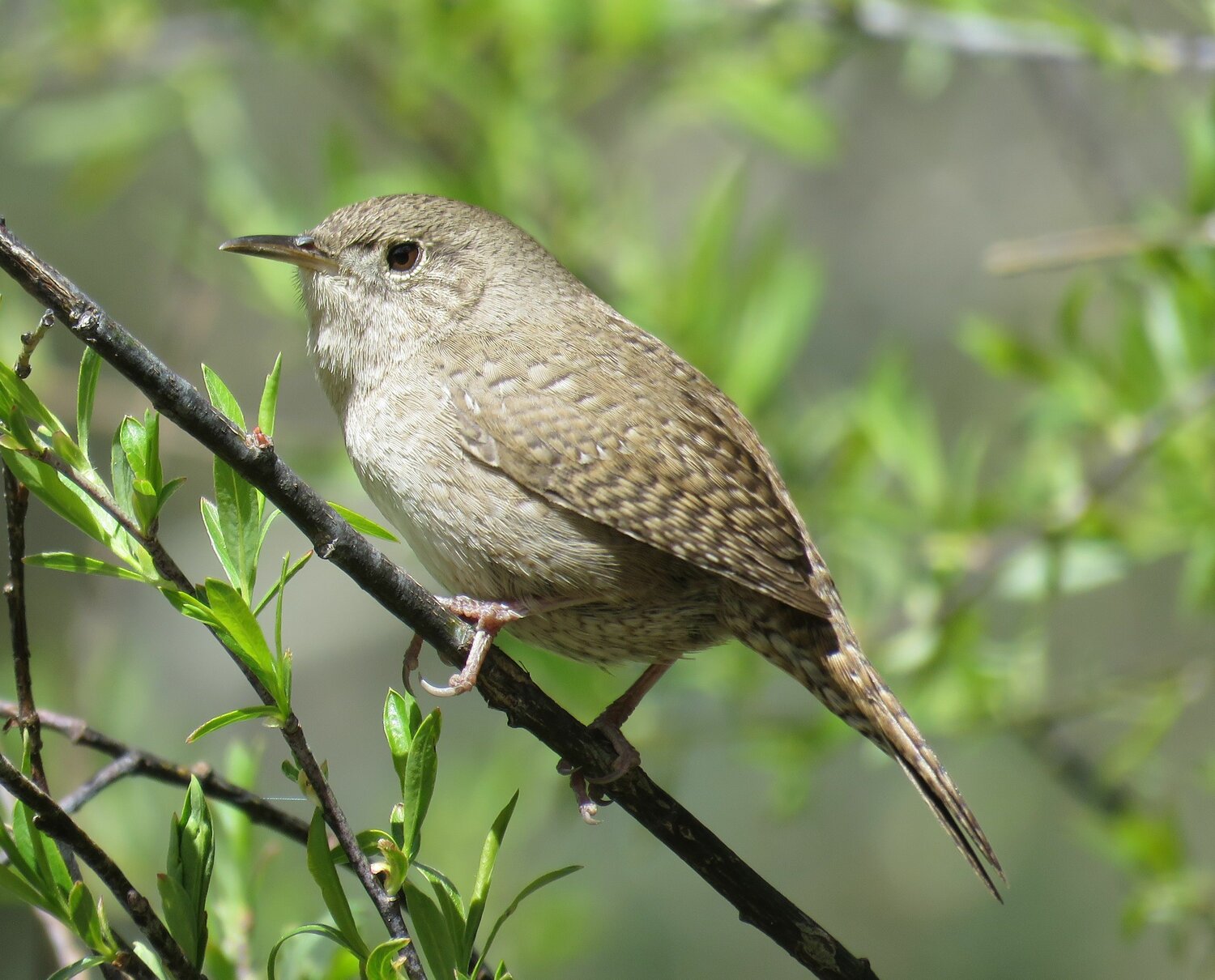
This week’s Bird of the Week, compliments of the Weminuche Audubon Society and Audubon Rockies, is the northern house wren.
In summer, this is a common backyard bird across most of the United States and southern Canada. Elements of their simple habitat requirements — which include trees, shrubs, tangles and clearings — are found in yards, parks or open woods. They require cavities for nesting and often use old woodpecker holes in snags, but they also fare well around people and use nest boxes, old cans, boots left outside, drainpipes, and nooks and crannies in human structures.
Physically, the northern house wren is a rather nondescript little brown bird with barring on the tail and wings. It spends its time hopping around with tail cocked in brush, or scouring bark to feed on a variety of insects and spiders. However, the boldness it lacks in appearance is countered by its feisty behaviors.
It can be surprising to trace the source of such a loud song to such a small bird. During breeding season the long, bubbly song of the male will reveal him advertising his availability and territory. Your presence, if viewed as a threat, will elicit a mix of harsh, chattering, scolding calls coming from within the brush.
Often to the detriment of bluebirds, tree swallows, chickadees and other birds, northern house wrens are fierce competitors for nest holes. Males may start building several nests at once to entice a female who seems to select a mate based on his nest-building skills over his physical attributes. He piles the nest cavity full of twigs to support the soft nest bed finished by the female. Twigs are a barrier at the entrance for protection from the cold, predators and cowbirds. He may also add some spider egg sacs to the interior. The spiders that hatch eat parasites and mites that are harmful to nestlings.
All of the house wren’s dummy nests may limit competition from other cavity nesters who arrive to find choice spaces filled. House wrens may pierce the eggs and kill the nestlings of even larger species to give their own young a better chance to survive. The scientific name of the northern house wren, Troglodytes aedon, includes a reference to the myth of a Greek queen, Aedon, who accidentally killed her own son when trying to murder a rival’s.
For information on events, visit www.weminucheaudubon.org and www.facebook.com/weminucheaudubon/.
Photo courtesy Byron Greco


 >